Orientation, Not Information

We have gotten remarkably good at putting information within reach.
Search it. Ask for it. Summarize it. Capture it. Retrieve it later.
I’ve been experimenting with another problem:
What helps us know where we are?
While working with a small heads-up display, it would have been easy to keep adding information. More notes. More tasks. More context. More things worth remembering.
Instead, the interesting work has been deciding what not to show.
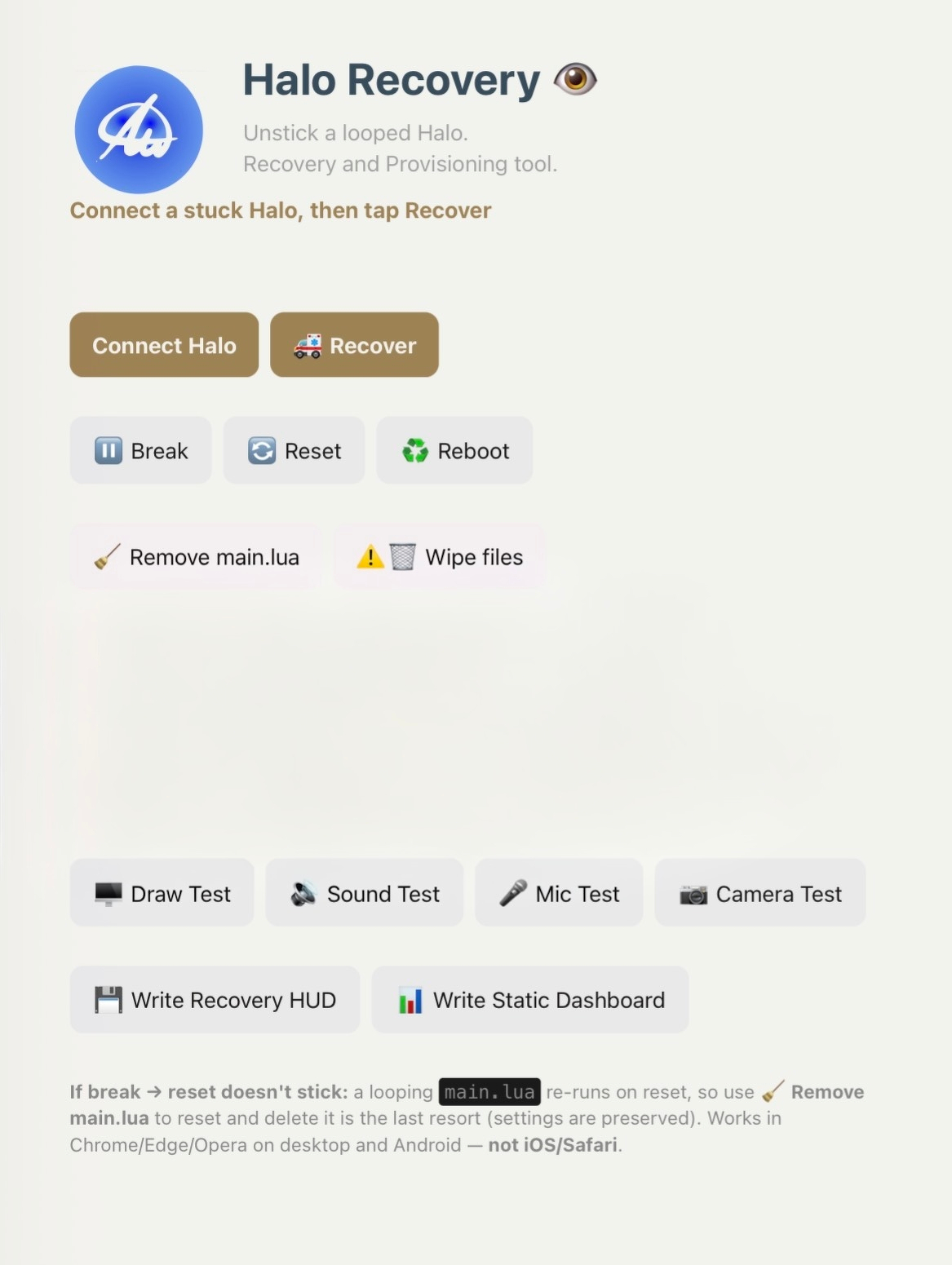
I’ve made part of that experiment public through Halo Recovery, a browser-based recovery and diagnostics tool I’ve been developing for Brilliant Labs' Halo glasses. It began with a fairly practical problem — recovering an unresponsive device — but became a useful place to experiment with something else: what is the minimum state worth restoring when the goal isn’t simply recovering the technology, but helping the person wearing it recover their bearings?
A couple of lines from one context. A few things that need attention. Something worth remembering. Somewhere to put the thought that just appeared.
Not everything available.
Enough to recover my bearings.
That distinction increasingly matters to me.
Information answers questions like What do I know? What happened? What can I retrieve?
Orientation asks something different:
Where am I in relation to what matters right now?
The difference isn’t limited to a display worn on your face.
Teams can have enormous amounts of information and still lack orientation. Organizations can measure everything they know how to measure and remain uncertain about what deserves attention. AI can make knowledge extraordinarily accessible without necessarily making our relationship to that knowledge any clearer.
More information may sometimes make the problem worse.
This is part of what I mean by orientation architecture.
The opportunity isn’t always to create another place for information to go. Sometimes it’s to design the conditions that help someone notice what matters, understand their present position, and retain enough context to choose what happens next.
That may require information.
It may also require subtraction.
Increasingly, I think one of our emerging design problems isn’t access to knowledge.
It’s preserving our ability to find our bearings within it.