
Thinking Spaces

Over the past weeks, I’ve been finding something of a flow with some new experiments. Between LLMs and Muse, I’ve been pushing the canvas a bit more into the cognitive-augmented spaces. In doing so, it’s causing insights to begin peeking out of the ground. The latest of these exposed in paraphrasing a comment during the previous week’s notable reads:
I use devices as thinking surfaces—places to temporarily hold and shape thoughts so I don’t have to carry everything in my head while working.
As pointed out so neatly in one of the LLM conversations, most people treat devices as:
- destinations (apps you go into)
- systems of record (CRMs, notes, forms)
- interfaces to complete tasks
I treat them as extensions of a cognitive canvas. And as this different category, am often coming across usages, behaviors, and insights which are found more along the lines of “revelations.”
In an engagement predating Avanceé, I worked for a community-fitness organization in a managerial role. The company was in the midst of several personnel and operational transitions, and I got to be a part of the process, almost accidentally. From implementing a team blog, to creating digital forms to replace carbon paper forms, to even remapping a few governance processes, I was able to deftly integrate my cognitive processes once I figured out how to improve my own information fidelity, then expand that to various enhancements others could utilize.
This started when asking “why.” Why couldn’t we use a tablet to interface with people on the floor? Why wouldn’t we use a checklist to improve visitor experience? Why not use asynchronous messaging versus a print binder and inconsistent accountability. And then from those questions were short, approachable personal experiments, often kept very quiet until they tested well. Then they were expanded bit by bit, allowing for critique and form to reshape as necessary. Some items found scale quickly, and I pivoted from researcher to trainer/implementer. A few failed marvelously. A few lingered for many years after I left… often unchanged.
Exploring meant developing a means to figure out how to extend cognitive processes such that me/someone is temporarily super-powered. We went from “wait, let me look that up for you” all the way to, “here’s how you can…” with a audit trail, feedback loop, and even nearer-to-realtime changes. Taking a decision and enabling someone to perceive it differently caused a different kind of output. In the case of the aforementioned org, the output became measured in community engagement, realistic fitness goals, and professional development paths more aligned with the capacity and capability of the organization.
Most tools are designed around: input → process → output My work flows differently: perception → capture → reflect → decide
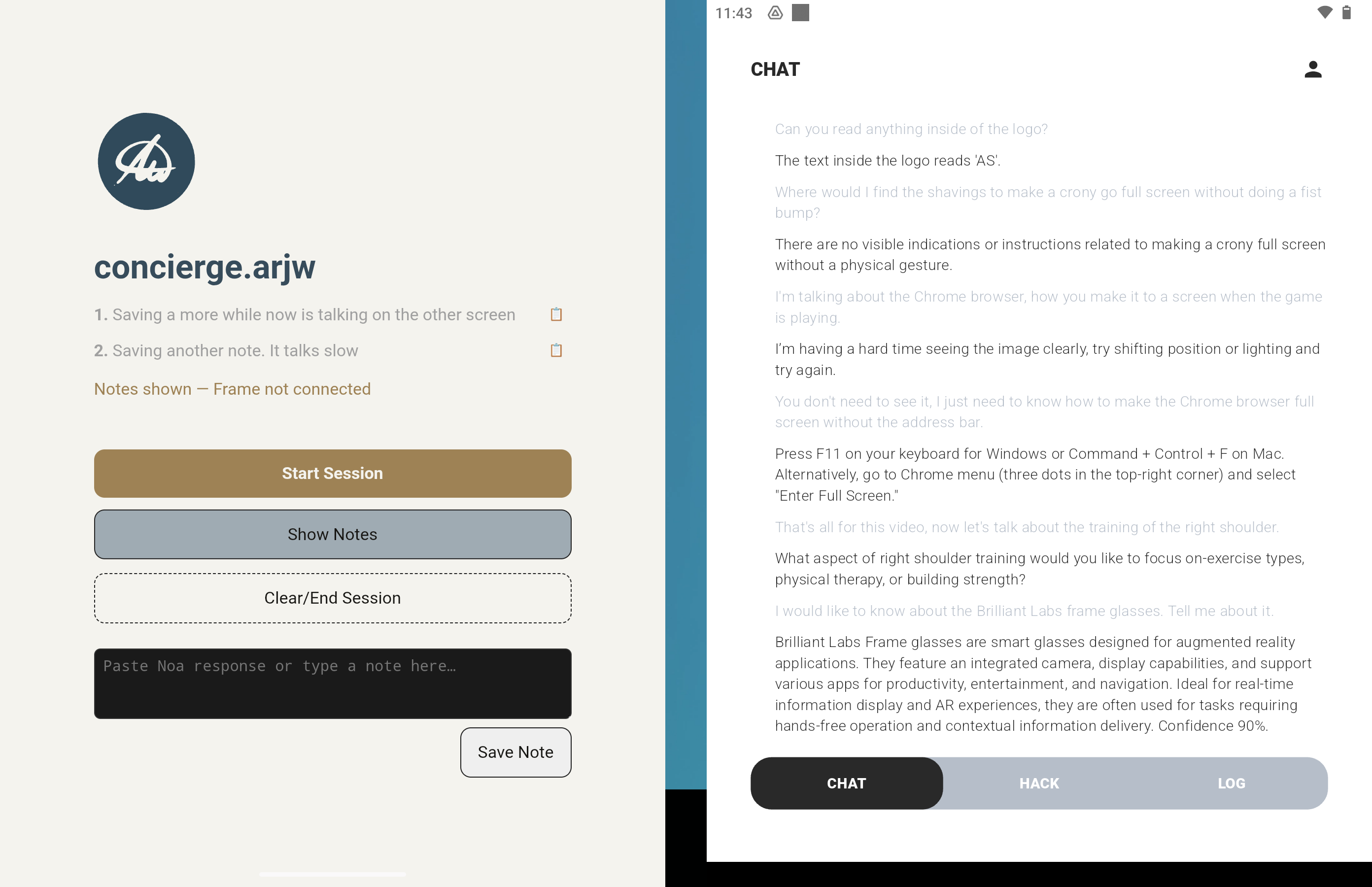
This is what makes one of the recent experiments so exciting. There’s this shape of “ok, here’s something which needs a layer of contemplation which has to happen differently, can you offload the harder part and come back to it?” And so I’m looking at the Brilliant Lab Frame glasses, Microsoft Duo, and a web app like “yea, we can figure out something.”
That middle space—between perception and decision—is where the bulk of work lived. It’s a different category in several facets. And one where the stories knit a deeper thread than simply “things to get done.” This is why Muse factors here so heavily. This is why we grapple less with “here’s a framework” and more with “we aren’t tech support.” If you can be empowered to extend your capabilities, then what you might be reaching for doesn’t just become attainable, but also embeds itself into the very fabric of your reason for being.
Could we do the same for you? Probably. There’s a more realistic answer though in that we are probably more equipped to help you discover the same cognitive canvas, and then help you sharpen your use of the tools you know in order to make that superpower more apparent and utilized by you.